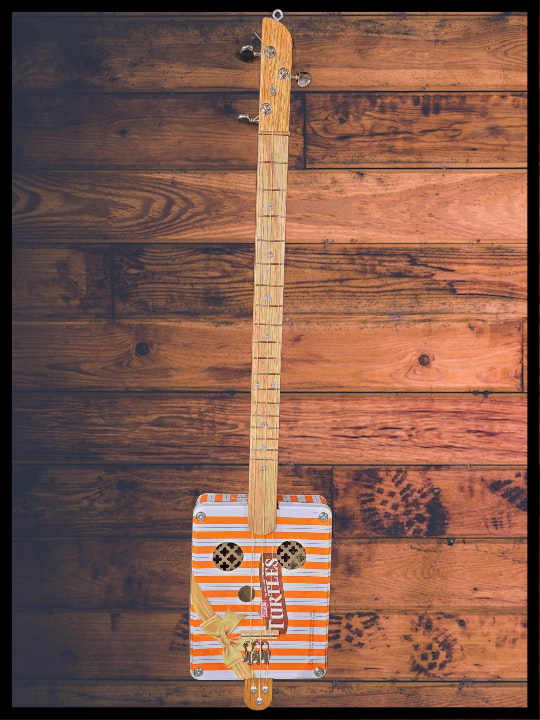
This build has been inspired by my love of the chocolatey goodness that is Turtles, my wife normally buys me a box of the gooey chocolate snack at Christmas time. One year she happened to buy the metal tin box, the box has been hanging around my garage/workshop for the past several years. The box itself is a great size and would make an excellent Cigar Box Guitar, or should I say Turtle Box Guitar!
So, as I always say “Hey why not”
let’s get to it.
NECK
I started with a beautiful piece of Red Oak; it has some great markings not the typical Oak grain, it has some deep tones. The neck was 38” inches in length, I decided that this build will be a thru body neck so final length is 35” inches. Tuning peg end has a curved hand sanded edge, the string end has also been curved and hand sanded to give a better look and smooth feel.
Length of the neck piece has been sanded to a smooth finish for a very comfortable grip and feel. Neck was then stained with Varathane Antique Walnut finish and sealed with Varathane Clear Gloss Triple coat spray.
FRET BOARD
The fret board on this build is a 20” inch piece of Oak with a rounded edge at the guitar body. Finish used on the fret board was Min-wax Natural 209 Penetrating stain, then sealed with Varathane Clear Gloss Triple coat spray. The spray gives a very smooth and glossy look and feel. Prior to finishing the fret board, I also decided to make this build a fretted guitar, so before actually applying the final finish I fretted the board.
I used Medium/Medium Nickle-Silver Fret wire,
Crown Width .084” (2.13 MM)
Crown Height .039” (0.99 MM)
Tang Depth .055” (1.40 MM)
18 pieces of fret wire was hand cut and filed to the round edges for a smooth feel. Fret slots were hand cut using a CBGitty Fret Mitre box and a 35-380 Dovetail Thick Kerf Razor saw with 18 TPI (Teeth Per Inch) and a .020 (508 MM) thick blade. Saw was also purchased from CBGitty.
Fret Markers are indicated by Nos. 8 – ¾” inch countersunk Robertson Wood Screws, which also fasten board to the neck. I like to use wood screws rather than glue. This makes any repairs to neck or fret board much simpler to remove.
BODY/BOX
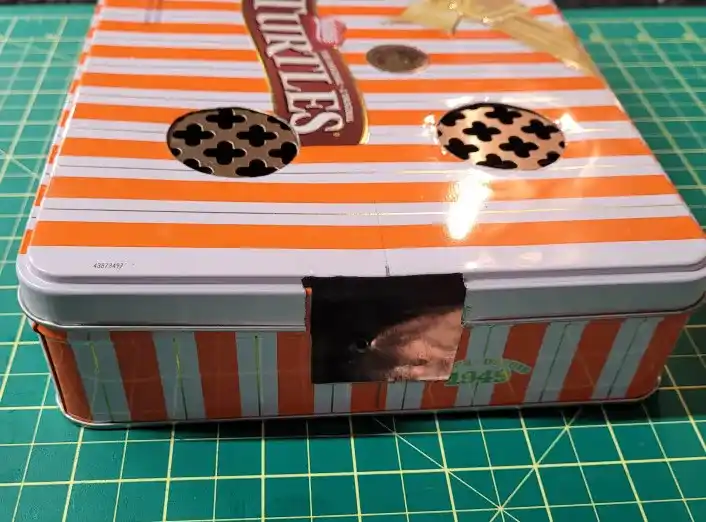
As I mentioned at the beginning the box of this guitar is a metal tin Turtles box. To find the center of the box I used a CBGitty Center Ruler, which has a Center mark in the middle and inch markers on either side of the ruler, you take the ruler across width of the box and when the inch marks are equal on both sides of the box you have found the middle of the box. The neck slots or holes were marked out in similar fashion, I used a CBGitty Neck Ruler which works the same way as Center Ruler, except it has the neck slot cut out and you mark out and then cut the material out. Remember as I said earlier this is a thru box neck design so you will need cut a neck slot in end of the box. These measurements can also be found and marked out by using a ruler, and or tape measure, you don’t need to purchase any specialized tools.
The length of the neck from tuning peg end to the box is 24” inches, with 9-3/4” inches in the body and 1- 3/4” inches extending out the far end of box. This extension will act as the tailpiece for the guitar. I drilled 3 holes thru the tailpiece to run the strings thru.
STRINGS/PICKUP/BRIDGE/TAIL PIECE
As mentioned above the tail piece on the Turtle build is a 1- 3/4” inch piece of the neck that protrudes out the end of the box. I drilled 3- 5/16th” inch holes thru the neck which will allow the strings to run thru. Each hole has 2, 5/16th” x 1/8th” rivets, one in top and one in bottom of the hole. I removed the center nail part of the rivet by putting the rivet in a vise and tapping out with a hammer. This stops the string from digging into the neck while tightening the string and from distorting the hole shape.
The scale of “Turtle” is 25” inches, which means the “Nut” is 25” inches from the “Bridge” I use 25” inch in my builds but you can use any of the other scale lengths. “Nut” itself is a piece of Maple cut the width of the neck, I filed out a small groove in center and equal side of center of the “Nut” to help hold strings in place.
“Bridge” is another scrap piece of Maple with a piece of fret wire the length and center of. It also has a grooved filed in center and equal side of center to hold strings in place.
I used 3 fully sealed chrome locking tuning pegs. I like using the fully sealed pegs because they help to keep out dust and other contaminates, the locking ability helps to keep strings in tune, you can also use open gear pegs to give your build a more authentic look. You can use all kinds of different items as pegs, remember you are only limited by your imagination!
The top of the box has 2 – 1 -1/2” inch sound holes cut out, which have been covered from inside with a bronze colored .020th” aluminum plate that have been hot glued in place.
“Turtle” is an acoustic guitar which has been amplified by a 1 -1/8th” round Piezo pickup which has been placed directly under the bridge. It has been wired with a standard guitar jack and can be hooked up to most amplifiers via a patch cord.
The strings I used are a bulk Phosphor Bronze which I purchased from CBGitty. The strings are .026. .034 and .044, the guitar is tuned to Open G which is G D G, these strings give a warm, mellow tone.
PARTING THOUGHTS
Well above is the finished guitar, it turned out very good and sounds quite nice. I always find it very exciting to see what the finished guitar will look and sound like. It is also very satisfying to take something like a cigar box or in this case a metal tin box and make a playable instrument.
I hope you found the “Turtle” build interesting, with the hope it may inspire you to try your hand at making a guitar. You may have an old tin or box hanging around that you could use to make an instrument you might want to play around on or a conversation piece to hang on your wall.
If you have any comments, questions please send them along and I will do my best to answer. Will be posting more of the CB guitars I have built and will be doing a start to finish video in the near future.
So until then take care, stay safe